Let the Edge Take the Hit: How Upstream Providers Harden Your App
By Pralhad7 MIN READ
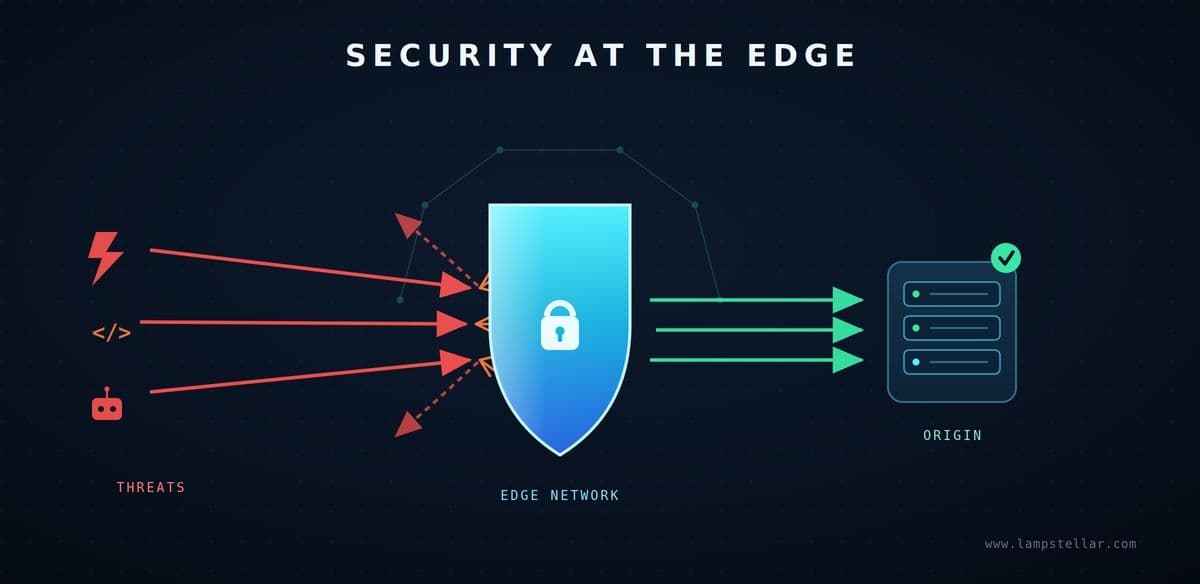
Every request to your app has to arrive from somewhere, and the honest truth is that some of those requests are hostile - a flood trying to knock you offline, a probe hunting for an injection flaw, a bot stuffing stolen credentials. The question isn't whether that traffic shows up. It's where it gets stopped. And one of the highest-leverage security decisions you can make is to stop it upstream - at the edge, before it ever reaches your origin.
That's what upstream providers like Cloudflare and Amazon CloudFront give you. They sit in front of your application, and every request passes through their network before it touches your servers.
Because they operate at enormous scale and see traffic across millions of sites, they can absorb, inspect, and filter threats in ways you couldn't practically build yourself. You get a world-class security layer you didn't have to engineer - if you configure it well and understand what it does and doesn't cover.
First, what "upstream" means
Your origin is where your app really lives - your servers, containers, or functions. An upstream provider is the layer that stands between the public internet and that origin. Traffic hits their global edge network first; they process it - cache, inspect, filter, challenge - and only forward what's legitimate to you.
The security value comes from that position. Nothing bad reaches your origin without first passing through infrastructure purpose-built to catch it, backed by a network far larger than yours. You're not replacing your own security; you're putting a shield in front of it.
Here's how that layer actually protects you.
01. DDoS absorption: capacity you'll never have alone
They soak up floods so your origin doesn't fall over. A distributed denial-of-service attack tries to overwhelm you with traffic - either raw volume at the network layer or a barrage of expensive requests at the application layer. The defense is capacity, and edge providers have capacity measured in terabits per second, orders of magnitude beyond any single origin.
When an attack hits, it hits their network, which absorbs and disperses it across a global footprint. Your origin often never even notices. This is protection you fundamentally cannot replicate on your own infrastructure - it only works because the provider is aggregating defense across a massive shared network.
02. Web Application Firewall: filtering the malicious request
A WAF inspects requests and blocks known attack patterns before they reach your code. SQL injection, cross-site scripting, path traversal, and the rest of the common exploit classes have recognizable signatures, and edge WAFs ship with managed rulesets - continuously updated - that catch them at the door.
The strength here is that the provider maintains and improves those rules for you, informed by attacks they see across their entire customer base. A new exploit pattern spotted against one site becomes a rule protecting yours. That's defense in depth: even if a vulnerability slips into your code, the WAF gives you a chance to block the exploit before it lands.
03. TLS termination: encryption done right, by default
They enforce and manage encryption so every connection is protected and modern. Upstream providers terminate TLS at the edge, handle certificate issuance and renewal automatically, and let you enforce HTTPS everywhere, modern cipher suites, TLS 1.3, and headers like HSTS.
The security win is twofold: no more expired-certificate outages or weak-cipher misconfigurations, and a consistent, current encryption posture applied uniformly - rather than something each service has to get right on its own.
04. Origin concealment: you can't attack what you can't find
Put the edge in front and your real servers stop being a public target. When traffic routes through an upstream provider, the internet sees the provider's addresses, not your origin's. Attackers hit the edge, not you.
You compound this by locking your origin down so it only accepts traffic from the provider - via authenticated origin pulls, allow-listed edge IP ranges, or mutual TLS. Done right, there's no direct path to your servers from the open internet at all. (Do it wrong - leak your origin IP somewhere, or leave the origin openly reachable - and you hand attackers a way to bypass the whole shield. More on that below.)
05. Rate limiting and bot management: stopping abuse and automation
They throttle abusive clients and separate humans from hostile bots. Rate limiting caps how many requests a client can make, blunting brute-force logins, credential stuffing, scraping, and API abuse. Bot management goes further, using behavioral signals and challenges to tell legitimate automation from malicious.
Because the provider sees these attack patterns constantly across its network, it recognizes bad actors faster than you could from your traffic alone - and blocks them at the edge before they cost you anything.
06. Threat intelligence: the network effect as a security asset
You inherit what the provider learns from everyone else. This is the quiet superpower of an upstream layer. A provider protecting millions of properties has a live, global view of malicious IPs, emerging attack campaigns, and new exploit techniques. Reputation data, geo and IP-based blocking, and rapid rule updates all flow from that vantage point.
An attack pattern that hits someone else today becomes a defense protecting you today - a network-effect advantage no single company's security team can match on its own.
07. Access control and observability at the edge
You can gate access and see what's happening before traffic reaches you. Modern edge platforms let you enforce access policies at the edge - zero-trust authentication in front of internal tools, IP allow-lists, and identity checks - so unauthorized requests are turned away before they touch your app. And because everything flows through one layer, you get unified logging and analytics on traffic and security events, giving you visibility that's hard to assemble from origin logs alone.
The catch: it's a shield, not a substitute
Upstream security is powerful, but it isn't a force field, and misunderstanding that is how teams get burned.
Shared responsibility is real:
The edge protects the perimeter; it does not fix insecure application logic, broken authentication, or exposed secrets. A WAF may block a known exploit pattern, but it won't save you from a genuine flaw in how your app handles authorization. Keep securing your origin as if the edge weren't there - because defense in depth means layers, not a single wall.
Don't defeat your own shield:
The most common failure is leaving a bypass: a leaked origin IP, an origin that still accepts direct traffic, a subdomain that points around the edge. Lock the origin to accept only edge traffic, or the concealment buys you nothing.
Configuration is where the security lives:
These platforms are only as strong as how you set them up. Default settings are a start, not a finish - tune the WAF, set sensible rate limits, enforce the TLS and access policies you actually need.
An AI-native note: protect the expensive endpoints
If your product is AI-native, upstream protection earns its keep in a specific way: your inference endpoints are expensive. Every request can cost real compute, so an unthrottled or scraped API isn't just a security problem, it's a runaway bill. Rate limiting and bot management at the edge cap abuse before it turns into cost, and they slow automated attempts to scrape or exhaust your AI endpoints. One honest caveat: an HTTP-layer WAF filters malicious requests, but it won't catch prompt injection, which is a semantic attack inside otherwise-valid input - that defense lives in your application, not at the edge. The edge protects the pipe; you still protect the model.
Final Thought
The smartest security move is often not building more, but positioning the traffic so threats get stopped before they reach you. Upstream providers give you DDoS capacity you could never provision, a continuously updated WAF, encryption done right by default, a hidden origin, edge-level rate limiting and bot defense, and the network-effect threat intelligence of a provider watching the whole internet at once.
Configure it well, keep securing your origin behind it, and understand where its protection ends and yours begins. Do that, and you let the edge take the hit - so your app doesn't have to.