Blog / Forward Deployed Engineer
How AI and Product-Led Growth Are Reshaping FDE, TAM, and CSM Roles
By Pralhad7 MIN READ
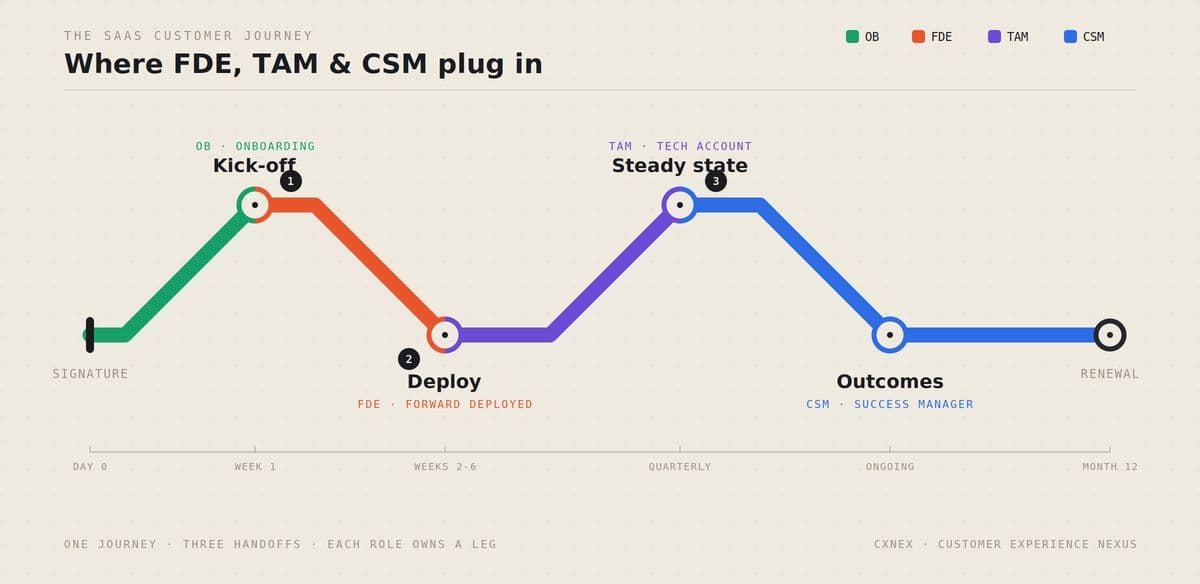
Five years ago, if you asked a SaaS founder to explain the difference between a Forward Deployed Engineer, a Technical Account Manager, and a Customer Success Manager, you'd get a fairly clean answer. FDEs build. TAMs advise. CSMs nurture. Three roles, three lanes, minimal overlap.
Ask the same question today and you'll probably get a pause, a laugh, and something like "honestly, it depends on the quarter."
That's not a sign of organizational sloppiness. It's a sign that two massive forces - AI and product-led growth - are rewriting the job descriptions faster than HR can update them. Let's dig into what's actually changing, and what it means whether you're hiring for these roles or working in one.
A quick refresher on the old boundaries
Before we talk about how the lines are blurring, it helps to remember where they used to be drawn.
The Forward Deployed Engineer was popularized by Palantir. The idea: send actual software engineers to sit with the customer, understand their messy real-world problems, and write code to bridge the gap between the product and what the customer actually needs. FDEs shipped custom integrations, data pipelines, and configurations. Their success metric was simple - does the thing work in production?
The Technical Account Manager lived one layer up. TAMs didn't usually write production code, but they knew the product's guts. They handled architecture reviews, escalations, upgrade planning, and the dreaded "why is this slow?" conversations. A good TAM was part translator, part firefighter, part therapist for the customer's IT team.
The Customer Success Manager owned the relationship and the renewal. Adoption metrics, QBRs, executive check-ins, expansion conversations. Less technical depth, more business fluency. The CSM's north star was net revenue retention.
Clean, right? Now let's mess it up.
Force 1: AI is eating the routine work in all three roles
Here's the uncomfortable truth nobody puts in the job posting: a meaningful chunk of what these roles did in 2021 is now automatable.
For CSMs, the shift is most visible. Health scores used to be assembled manually from usage dashboards and gut feel. Now AI-driven platforms flag at-risk accounts before a human notices anything wrong. QBR decks that took half a day to build can be drafted in minutes. Even the "checking in!" email - the most parodied artifact of the CS profession - is being generated, personalized, and sent without a human touching it.
Does that mean CSMs are doomed? I don't think so, but the role is bifurcating. The low-touch, dashboard-monitoring version of the job is disappearing. What remains is the genuinely hard part: navigating a customer's internal politics, negotiating a tricky renewal, convincing a skeptical VP that the product deserves more budget. AI can't sit in that room. Yet.
TAMs are feeling it too, though differently. AI-powered support deflection means fewer tier-one escalations reaching them. Documentation copilots answer configuration questions that used to fill a TAM's inbox. The result is that TAMs are being pushed toward higher-stakes work - architecture strategy, security reviews, multi-year technical roadmapping - because the routine stuff handles itself.
And FDEs? Interestingly, AI is making the FDE model more viable, not less. Coding assistants let a single FDE do the integration work that previously needed a small team. The economics of embedding an engineer with a customer used to only make sense for seven-figure contracts. That math is changing.
Force 2: PLG flipped the customer journey upside down
Product-led growth changed who these roles talk to and when.
In the classic enterprise sales motion, the FDE/TAM/CSM trio showed up after a big contract was signed. The customer had already committed; the post-sale team's job was to deliver on promises made by sales.
PLG inverts this. Users sign up self-serve, adopt the product on their own, and only later - maybe - does a sales conversation happen. By the time a CSM enters the picture, the customer might already have 200 active users and strong opinions about the product. The CSM isn't driving adoption from zero; they're harvesting and expanding adoption that already happened.
This has a few knock-on effects worth noticing:
CSMs need product analytics fluency, not just relationship skills. In a PLG company, the customer's usage data is the relationship. A CSM who can't read a product analytics dashboard and spot an expansion signal is flying blind.
TAMs shift from reactive to proactive. When customers onboard themselves, they also break things themselves. TAMs in PLG companies spend more time building guardrails, templates, and reference architectures - scaling their expertise through assets rather than one-on-one calls.
FDEs become the bridge for the "PLG-to-enterprise" leap. Here's a pattern I keep seeing: a company grows bottom-up through self-serve adoption, then lands a genuinely huge enterprise deal - and suddenly needs deep customization, SSO integration, data residency work, the whole enterprise checklist. FDEs are increasingly the team that makes that leap possible. The AI-native companies (Anthropic, OpenAI, and a wave of startups following their lead) have leaned hard into this, hiring FDEs to turn general-purpose platforms into specific enterprise solutions.
The convergence: rise of the hybrid roles
Put those two forces together and you get the real story - the roles aren't just changing individually, they're converging.
Look at job boards right now and you'll find titles that didn't exist a few years ago: "Technical CSM," "Solutions Engineer, Post-Sales," "Customer Engineer," "Forward Deployed Solutions Architect." These aren't rebrandings for the sake of novelty. They reflect a genuine compression of the old three-role stack into fewer, more technical, more commercially aware positions.
The pattern goes something like this:
- The floor for technical skill is rising everywhere. A CSM at an AI infrastructure company is expected to understand APIs, tokens, and rate limits. Not to code, necessarily - but to hold a credible technical conversation without phoning a friend.
- The ceiling for business skill is rising too. FDEs who used to be judged purely on shipped code are now expected to spot expansion opportunities and flag churn risk. Engineers with commercial instincts are worth their weight in gold, and companies know it.
- Ratios are stretching. One TAM to five accounts is becoming one TAM to fifteen, with AI handling the routine load. The humans are reserved for the moments that actually need humans.
So what should you do about it?
If you're hiring: stop copying job descriptions from 2019. Decide what your customers actually need at each stage - hands-on building, technical guidance, or commercial stewardship - and staff for that, even if the resulting role doesn't fit a standard title. And be honest in the posting about how technical the role really is. Nothing burns a new CSM faster than discovering on day one that "customer conversations" means debugging webhook failures.
If you're in one of these roles: move toward the work AI can't do. For CSMs, that means deepening technical fluency and getting sharper at commercial negotiation. For TAMs, it means owning strategy, not tickets. For FDEs, it means pairing your engineering skill with genuine curiosity about the customer's business - the code was never the whole job anyway.
If you're a customer: expect fewer, better people on your account. The days of a large vendor team where half the faces on the kickoff call never appear again are ending. What replaces them is a smaller crew with broader skills, backed by AI tooling that handles the routine.
The bottom line
FDE, TAM, and CSM were always three answers to the same underlying question: how do we make sure the customer succeeds after the contract is signed? AI and PLG haven't changed the question. They've changed the economics of answering it.
The lanes are merging. The people who thrive won't be the ones defending their old job description - they'll be the ones who noticed the lines blurring and stepped across them first.